
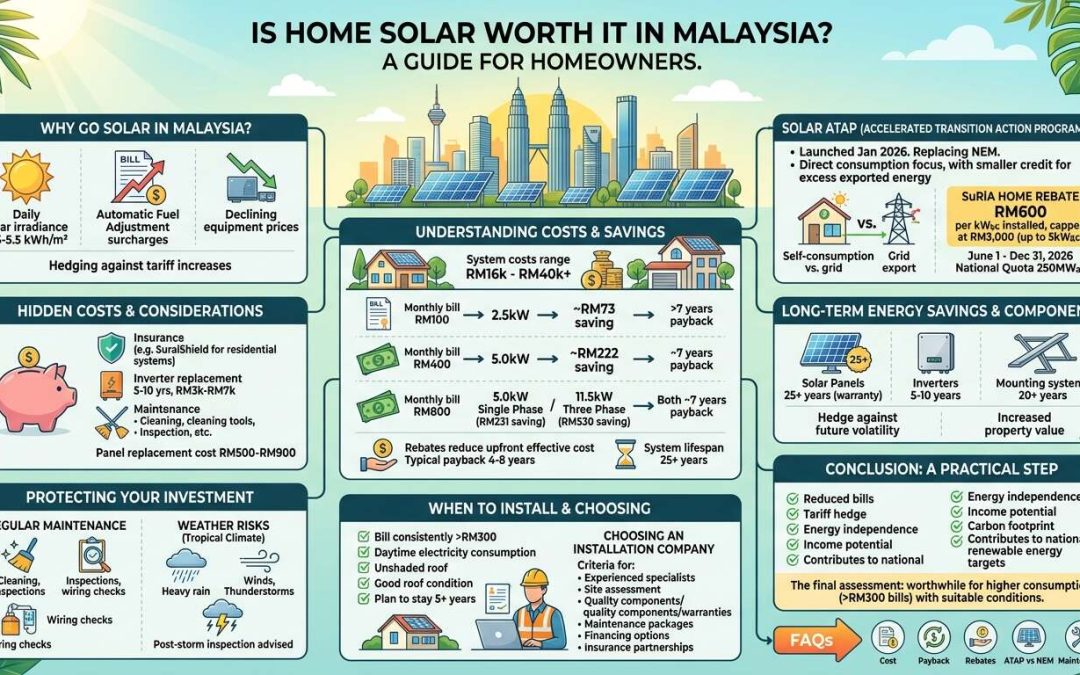
Malaysia receives abundant sunshine throughout the year, with solar irradiance ranging from 4.5 to 5.5 kWh/m² per day. This makes the country naturally suited for solar energy. Rising electricity costs, government incentives, and declining equipment prices have made home solar panels increasingly attractive for Malaysian homeowners.
Many homeowners hesitate because of the upfront investment. A typical residential solar system can cost between RM16,000 and RM40,000 or more, depending on system size and property type. However, the financial equation has shifted with new government programmes designed to accelerate adoption.
This raises an important question: do the long-term savings justify the initial cost?
What Is Solar ATAP?
Solar ATAP (Accelerated Transition Action Programme) is Malaysia’s current solar rooftop scheme, managed by the Sustainable Energy Development Authority (SEDA) and the Energy Commission. Launched in January 2026, it replaces the previous Net Energy Metering (NEM) programme.
Under Solar ATAP, the focus shifts to direct consumption. Homeowners generate electricity during the day and use it immediately to reduce their Energy Charge. Excess electricity exported to the grid is credited at a lower rate compared to NEM’s 1-to-1 offset system.
The programme includes the SuRIA Home rebate scheme, offering RM600 per kWac installed, capped at RM3,000 for systems up to 5kWac. This rebate is available from June 1 to December 31, 2026, with a national quota of 250MWac.
Why Home Solar Panels Are Important
Electricity tariffs in Malaysia have been rising. The Automatic Fuel Adjustment (AFA) rate shifted from a rebate of -0.47 sen per kWh in April 2026 to surcharges of +1.38 sen in May and +2.92 sen in June. For households consuming above 600kWh monthly, these increases directly impact bills.
Solar panels help homeowners:
- Reduce monthly electricity bills
- Hedge against future tariff increases
- Lower carbon footprint
- Increase property value
- Protect against energy price volatility
Early adoption often prevents exposure to escalating energy costs.
Understanding the Costs and Savings
The financial case for solar depends heavily on your electricity consumption. Higher bills mean faster payback periods.
For a household with a monthly bill of RM100, a 2.5kW system could save approximately RM73 monthly, with a payback period exceeding seven years.
For a monthly bill of RM400, a 5.0kW system could save approximately RM222 monthly, with a payback period of around seven years.
For a monthly bill of RM800, a 5.0kW single-phase system could save approximately RM231 monthly, while an 11.5kW three-phase system could save approximately RM530 monthly. Both scenarios offer payback periods of around seven years.
For homeowners with monthly bills of RM300 to RM350, the payback period can extend to seven years. Households with bills around RM900 may see payback in approximately four years.
The SuRIA Home rebate reduces the effective upfront cost by up to RM3,000. A 6.1kWp system costing RM19,000, for example, becomes RM15,000 after rebate, shortening the payback period.
Identifying Hidden Costs and Considerations
The upfront installation cost is not the only financial factor to consider.
Common additional costs include solar panel insurance to protect against damage from falling objects, rodents, or extreme weather. Inverter replacement is typically needed every five to ten years, costing between RM3,000 and RM7,000. Periodic maintenance and cleaning should also be factored in. Some homeowners may also consider battery storage for higher self-consumption.
TNBX offers SuraiShield, a specialised insurance policy for residential solar systems. Replacement costs range from RM500 to RM900 per panel and RM3,000 to RM7,000 for inverters.
Supporting Long-Term Energy Savings
Solar panels are not only about reducing current bills. They also provide long-term financial protection.
System components have varying lifespans. Solar panels typically last 25 years or more with performance warranty. Inverters generally last five to ten years. Mounting systems can last 20 years or more.
Proper installation and maintenance ensure optimal performance throughout the system’s life.
The Importance of Regular Solar Maintenance
Routine maintenance maximises energy production and extends system lifespan.
Services may include panel:
- cleaning to remove dust, bird droppings, and debris
- inverter inspection
- wiring and connection checks
- performance monitoring
- vegetation management
Regular maintenance reduces efficiency losses and prevents small issues from becoming costly repairs.
Why Storm Damage Increases Solar Risks
Malaysia’s tropical climate brings heavy rain, strong winds, and thunderstorms. These conditions can damage solar installations.
Storms may cause panel:
- cracking or breakage
- mounting system failure
- inverter damage from power surges
- wiring disconnection
- water ingress into electrical components
A professional inspection after severe weather helps identify damage before it leads to complete system failure.
Commercial Properties Benefit from Solar Assessments
Businesses often have significant roof space suitable for solar installations.
Businesses under Solar ATAP can offset Energy and Capacity Charges through direct consumption. For commercial customers, direct consumption offsets approximately RM0.27 to RM0.31 per kWh, while exported energy is compensated at around RM0.18 per kWh.
When Should You Consider Installing Solar Panels?
Homeowners should consider scheduling a consultation when monthly electricity bills consistently exceed RM300.
- The property should have unshaded roof space facing north or south.
- The roof should be in good condition and structurally sound.
- The household should plan to remain in the property for five years or more.
- There should also be daytime electricity consumption from air conditioning, appliances, or EV charging.
High-consumption households with substantial daytime usage benefit most from solar.
Why Professional Assessments Are Better Than DIY Estimates
While homeowners can estimate their solar potential using online calculators, accurate system sizing requires professional assessment.
Solar specialists understand:
- roof orientation and shading analysis
- structural suitability
- electrical system compatibility
- optimal system sizing for your consumption profile
- familiar with available incentives and financing options
- grid connection requirements
They also use specialised tools to provide accurate production forecasts and savings estimates.
Long-Term Benefits of Home Solar Panels
Investing in solar provides numerous long-term advantages.
Benefits include:
- reduced electricity bills
- protection against tariff increases
- increased property value
- a lower carbon footprint
- gain energy independence
- potential income from excess generation
- contribute to national renewable energy targets
Preventive investment in solar is often more cost-effective than continued reliance on grid electricity at rising rates.
Choosing a Professional Solar Installation Company
When selecting a solar provider, consider companies that offer
- experienced solar specialists
- comprehensive site assessments
- quality components with warranties
- professional installation services
- maintenance and monitoring packages
- financing or rent-to-own options
- insurance partnerships
Working with experienced professionals ensures your system is sized correctly, installed safely, and performs optimally.
Conclusion
Home solar panels can be a worthwhile investment for Malaysian homeowners, particularly those with higher electricity consumption and suitable roof conditions. The combination of abundant sunshine, rising tariffs, government rebates, and declining equipment costs creates a favourable financial case for many households.
For homes with monthly bills exceeding RM300 and adequate daytime consumption, solar panels offer meaningful savings and protection against future cost increases. The payback period of five to eight years, combined with a system lifespan of 25 years or more, provides substantial long-term financial benefits.
Whether for landed homes, terraced houses, or properties with suitable roof space, solar panels represent a practical step toward energy independence and cost management.
FAQs
1. How much do home solar panels cost in Malaysia?
A typical residential solar system starts from approximately RM16,000, with costs increasing based on system size. A 5kW system may cost RM17,500 to RM22,500 before rebates. The SuRIA Home rebate reduces this by up to RM3,000.
2. What is the payback period for solar panels in Malaysia?
Payback periods range from four to eight years depending on electricity consumption and system size. Homes with higher bills typically see faster payback. Systems have a lifespan of 25 years or more, providing many years of savings after payback.
3. What rebates are available for home solar in Malaysia?
The SuRIA Home rebate offers RM600 per kWac installed, capped at RM3,000, for systems installed between June 1 and December 31, 2026. The programme has a national quota of 250MWac.
4. Is Solar ATAP better than the old NEM scheme?
Solar ATAP focuses on self-consumption rather than exporting to the grid. While NEM offered 1-to-1 credits for exported energy, Solar ATAP rewards direct consumption more. Homes with high daytime usage benefit most under Solar ATAP.
5. What maintenance do solar panels require?
Solar panels require periodic cleaning to remove dust and debris, inverter inspection, and wiring checks. TNB offers maintenance packages, and third-party providers offer annual servicing. Panels should be inspected after severe weather events.