
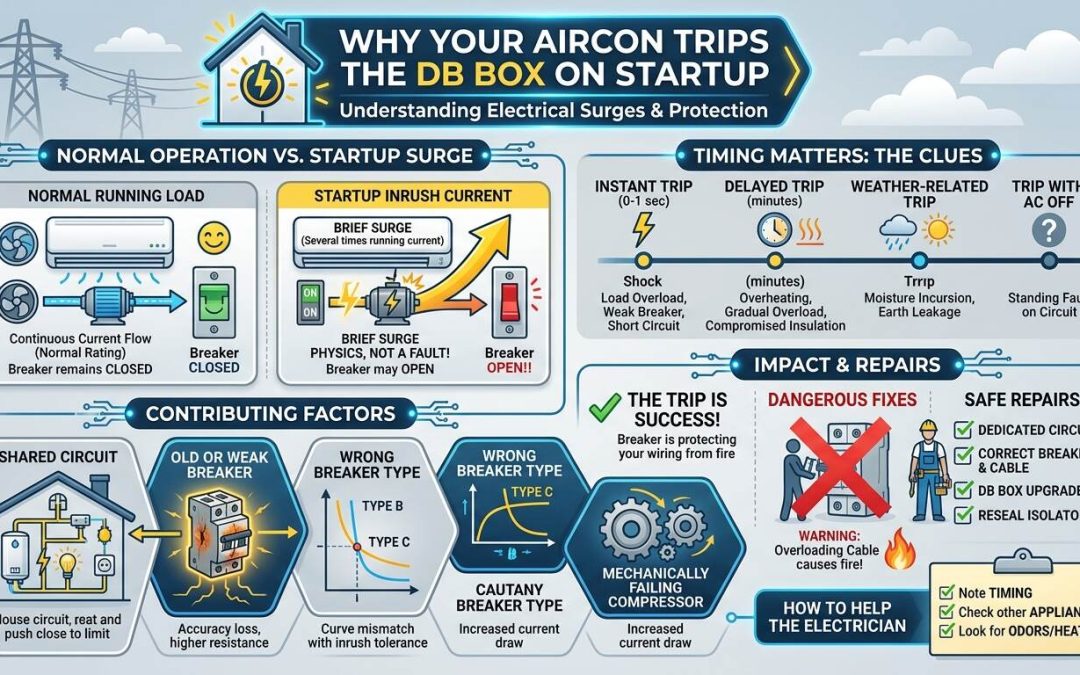
Here’s a scenario that plays out in thousands of homes every week. You press the remote. The aircon beeps, the fan starts spinning, and then, a second or two later, the whole room goes silent. You walk to the DB box, push the switch back up, try again, and the same thing happens. By the third attempt you start wondering whether the aircon is broken, whether the wiring is bad, or whether you should just give up and use a fan.
What most people never stop to consider is that the trip is not the aircon failing. It is the aircon succeeding at something your electrical system was never built to handle. The breaker is not the enemy here. It is the only component in your home that is doing its job correctly.
This article takes a different angle from the usual checklist of causes. Instead of listing faults, it explains what is actually happening on your circuit, why the timing of the trip matters so much, and how to read the clues your home is giving you before you call anyone.
The Trip Isn’t Random. The Timing Is the Clue.
One of the most useful things you can do before calling an electrician is note exactly when the trip happens. The timing narrows down the cause far more than most people realise.
- Instant trip on startup
- Delayed trip after a few minutes
- Weather-related trip
- Trip with the aircon switched off
Reading the timing correctly can save you money, because it tells the electrician where to look first instead of testing everything from scratch.
Why Aircon Startups Are Unlike Anything Else in Your Home
Every appliance has a startup moment, but aircon startups are different. The compressor is a motor, and motors briefly draw a surge of current several times their running level—physics, not a fault. Once running, current drops to normal.
If the circuit is already near its limit—a water heater on, several power points in use, or a weakened breaker—that startup surge pushes it over the edge and trips the breaker.
Key factors making aircon startup the hardest moment on any circuit:
- The compressor motor draws inrush current several times higher than its running load
- Startup happens in a fraction of a second, leaving no time for the circuit to adjust
- If other appliances are already drawing power, the margin for the surge disappears
- A weakened breaker may trip below its rated current during this surge
- The hotter the weather, the harder the compressor works and the higher the current draw
This is why an aircon can trip a breaker on startup but run fine for hours afterwards if you somehow manage to get it going. The startup is the hardest moment, and it is the moment your circuit is least able to cope.
The Things Nobody Tells You About Breakers
Most homeowners treat the breaker as a simple on-off switch. It is not. It is a calibrated protective device with a specific trip curve, and it degrades over time.
- A breaker that has tripped many times under fault conditions loses its accuracy and may begin tripping at lower currents than its rating suggests
- Contact resistance develops inside worn breakers, causing them to run warmer, which makes them trip sooner
- Different breakers have different trip curves, and the wrong type may trip on a perfectly healthy aircon simply because it cannot tolerate inrush current
- A mismatch between breaker type and load is not a fault in the aircon or the wiring, but a compatibility problem
- Replacing a tripping breaker with an identical one often fails because the original was the wrong type for the job
This is one of the reasons why simply swapping the breaker rarely solves the problem on its own.
The Most Expensive Mistake Homeowners Make
The most damaging response to a tripping breaker is installing a larger one. This removes the protection between your wiring and a fire. Breakers are sized to protect cables, not appliances—increase the rating without upgrading the cable, and the cable becomes the weakest link.
- The cable will overheat under loads it was never designed to carry
- Insulation degrades faster at higher temperatures
- Degraded insulation leads to short circuits and fire risk
- The breaker will no longer trip when it should, removing your last line of defence
- Insurance claims can be rejected if the installation is found to be non-compliant
The correct approach is the opposite. If the breaker is tripping, the question is not how to stop it tripping. The question is why the circuit is being pushed past its design limit, and whether the circuit needs to be upgraded rather than the breaker.
What the Fix Usually Looks Like
Once the cause is identified, the repair is usually straightforward, though the specifics depend on what the testing reveals.
- If the circuit is shared with other loads, running a dedicated line directly from the DB box to the aircon isolates it from everything else
- If the breaker is undersized or of the wrong type, it is replaced with one rated for the aircon’s actual demand and startup characteristics
- If the wiring is degraded or undersized, it is replaced with cable rated for the load, which is often the most involved part of the job
- If the compressor is failing, the aircon itself needs attention, and no amount of electrical work will fix a mechanically failing unit
- If moisture is the issue, the fix involves resealing the isolator, improving drainage around the outdoor unit, and replacing affected terminals or cables
- If the DB box is carrying too much on one side, redistributing circuits can reduce strain across the board
In most homes, the final solution combines two or more of these measures. There is rarely a single magic fix.
Why Waiting Makes It Worse
There is a temptation to treat the tripping as a temporary inconvenience. Reset the breaker, use the aircon for a while, reset it again. This works until it does not, and when it stops working, the consequences are usually expensive.
- Repeated trips under fault conditions stress the wiring, and each trip represents a moment of excess current through conductors not designed for it
- Over time, this degrades insulation and creates hot spots that can ignite nearby materials
- Repeated trips also stress the breaker, which may eventually fail closed and provide no protection at all
- If the underlying cause is earth leakage, the risk is not financial but personal, because current escaping to earth can pass through a person
- A small repair today is almost always cheaper than an emergency callout, a rewiring job, or a fire damage claim tomorrow
A tripping breaker is your home telling you something is wrong. The longer you ignore it, the louder it gets, and the more it costs to silence.
How to Prepare Before the Electrician Arrives
You can make the diagnosis faster and cheaper by gathering a few simple observations beforehand.
- Note whether the trip happens instantly, after a delay, or only in certain weather
- Check whether other appliances on the same circuit were running at the time
- Listen for any unusual sounds from the breaker panel or the aircon
- Note any smells, discolouration, or warmth around the DB box
- Write down how many times the breaker has tripped in the past month
- Check whether the trip affects the whole house or only part of it
- Take a photo of the DB box with the breaker positions visible
These details give the electrician a head start and often point directly to the cause without extensive testing.
A Different Way to Think About Your Electrical System
Most people think of their electrical system as a set of independent circuits, each doing its own thing. In reality, it is a single interconnected system with a shared capacity, and every change you make affects the whole.
- Adding an aircon to a circuit designed for lighting changes the load profile of that circuit permanently
- Upgrading one breaker without considering the cable it protects changes the safety margin of the entire system
- Ignoring a tripping breaker changes the risk profile of your home
- Every appliance added over the years contributes to the total load the system must carry
- The system does not fail suddenly. It fails when the accumulated strain crosses a threshold
The trip is not an isolated event. It is a symptom of an imbalance somewhere in the system, and the only way to resolve it properly is to understand what that imbalance is.
Conclusion
Your DB box trips because something in the aircon circuit is exceeding safe limits — load, resistance, moisture, a failing compressor, or a worn breaker. The trip isn’t a malfunction; it’s protection working as intended. The timing tells you more than the trip itself: startup points to load, delay points to heat, weather points to moisture, and a trip with the aircon off points to a standing fault. Fix the root cause, not the symptom — that’s basic electrical safety.
FAQs
1. Why does my aircon trip the DB box only at night?
Nighttime tripping often points to shared load. Other appliances, lighting, or water heating may be running at the same time, pushing the circuit past its limit when the aircon starts.
2. My neighbour’s aircon works fine on the same model. Why does mine trip?
Circuit design, cable size, breaker type, and total household load vary from home to home. Two identical aircons can behave completely differently depending on what they are connected to.
3. Can a weak compressor cause a trip without any other symptoms?
Yes. A compressor can degrade gradually, drawing slightly more current each month until it crosses the threshold. The trip is often the first obvious symptom.
4. Is it worth repairing an old aircon that trips the breaker?
It depends on the cause. If the fault is in the circuit rather than the unit, repairing the circuit is worthwhile regardless of the aircon’s age. If the compressor itself is failing, replacement is often more economical.
5. Does the size of my DB box matter?
Yes. A DB box with too few ways or an inadequate main breaker cannot support additional circuits. Upgrading the DB box is sometimes necessary before a dedicated aircon circuit can be installed.