
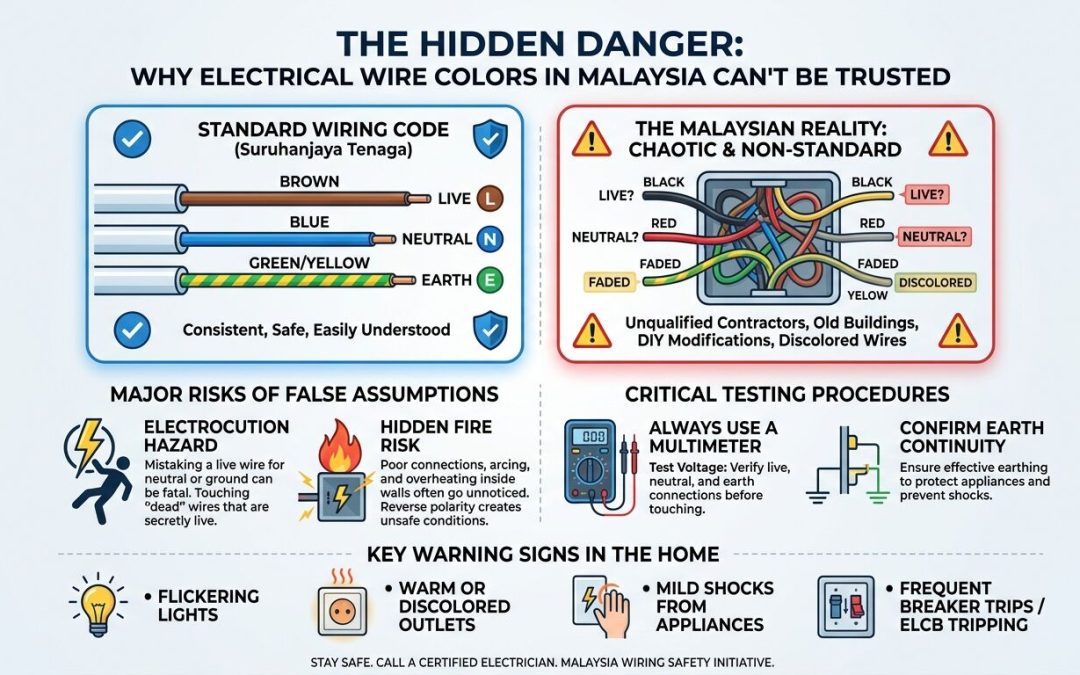
Every wire in your home has a color. Red, black, blue, yellow, green. These colors are supposed to tell electricians what each wire does. Red means live. Black means neutral. Green means earth. Simple, right?
Wrong.
In Malaysia, thousands of properties have wiring that does not follow any standard. Previous owners, unqualified contractors, and even well-meaning family members have created electrical systems where colors mean nothing. A black wire could be live. A green wire could be neutral. A red wire could be disconnected entirely.
This is not a rare problem. It is widespread. And it kills people every year.
The assumption that wire colors are reliable has led to electrocutions, house fires, and countless near-misses. If you own or manage a property in Malaysia, you need to understand why color codes cannot be trusted and what you must do instead.
The Myth of Standardized Wiring in Malaysia
Malaysia does have a wiring standard. Suruhanjaya Tenaga regulates electrical installations, and the guidelines are clear. For single-phase systems, live is brown, neutral is blue, and earth is green with yellow stripes. For three-phase systems, live wires are red, yellow, and blue.
But standards only work when people follow them.
The reality is that enforcement is inconsistent. Many electricians, especially those operating informally, do not follow the code. They use whatever wire is available. They connect things however they can. They prioritize getting the power back on over doing the job correctly.
This means that in any given property, especially older ones, the wiring could be a chaotic mix of standards, non-standards, and outright mistakes. The colors on the outside tell you nothing about what is happening on the inside.
How Wire Colors Become Meaningless
There are several ways that wire colors lose their meaning. Understanding these scenarios will help you see why visual inspection is never enough.
The Renovation Nightmare
A house is built in 1995 with standard wiring. In 2005, a renovation adds new lights and power points. The contractor uses whatever wire he has in his van. In 2015, another renovation extends the kitchen. The homeowner’s brother-in-law does the work on a weekend. By 2025, the wiring is a patchwork of different standards, different eras, and different levels of competence.
In this house, a blue wire might be neutral in one room and live in another. There is no way to know without testing.
The Imported Appliance Problem
Malaysians love imported goods. We buy appliances from Japan, Korea, Europe, and China. These appliances come with their own wiring conventions. If someone installs an imported appliance and uses the existing wiring without checking, they might connect live to neutral and neutral to live. The appliance will still work. The colors will still look correct. But the system is now dangerous.
The Fading and Discoloration Issue
Wire insulation does not last forever. Heat, humidity, and age cause colors to fade. A red wire becomes brown. A blue wire becomes grey. A yellow wire becomes indistinguishable from white. In older properties, identifying wires by color is like reading a book with half the words missing.
The Tape and Marker Problem
When electricians run out of the correct wire, they sometimes use tape or markers to indicate function. A black wire with red tape is supposed to be live. But tape falls off. Markers fade. Over time, the only indicator of function disappears, leaving a wire that looks like something it is not.
Real-World Scenarios That Endanger Lives
Abstract warnings are easy to ignore. Here are concrete scenarios that happen in Malaysia every day.
The DIY Ceiling Fan Installation
A homeowner buys a ceiling fan and decides to install it himself. He turns off the main switch, climbs up, and finds three wires: red, black, and green. He assumes red is live, black is neutral, and green is earth. He connects accordingly.
But in this house, a previous renovation swapped the live and neutral at the distribution board. The black wire is actually live. When the homeowner touches it, he receives a shock. If he is standing on a ladder, the fall could kill him.
The Office Renovation Disaster
A commercial office undergoes renovation. The contractor needs to add new power points. He finds an existing circuit and taps into it. He sees a blue wire and assumes it is neutral. But in this building, the blue wire is a live phase from an old three-phase system that was partially converted.
The new power points now have live current running through what should be the neutral line. Every appliance plugged in becomes a potential electrocution hazard. The error is invisible. The colors look correct. Only testing would reveal the truth.
The Fire Risk You Cannot See
Electrical fires are among the most destructive and most preventable disasters. They often start in hidden locations: behind walls, inside ceiling spaces, under floors. By the time smoke is detected, the fire has already taken hold.
Faulty wiring is a leading cause of electrical fires. The specific hazards include:
- Loose connections
- Overloaded circuits
- Damaged insulation
- Corroded connections
- Rodent damage
None of these hazards are visible from the outside. You cannot see a loose connection behind a wall. You cannot see overheating inside a junction box. You cannot see corrosion on a terminal. Only testing and inspection can reveal these threats.
Why Older Malaysian Properties Are Especially Vulnerable
Malaysia has a large stock of older buildings. Many were built before current wiring standards were introduced. Many have been renovated multiple times. Many have wiring that has never been professionally inspected.
These properties share common risk factors:
- Outdated wiring materials
- Undersized circuits
- Accumulated modifications
- Lack of documentation
- Deferred maintenance
If you own or live in an older property, the risk is real. The colors on your wires may mean nothing. The only way to know is to have the system professionally assessed.
What a Proper Electrical Assessment Involves
A professional electrical assessment is not a quick visual check. It is a systematic evaluation of the entire system. Here is what it should include:
- Checking for obvious signs of damage, overheating, or poor workmanship.
- Confirming that live, neutral, and earth are correctly identified.
- Ensuring that live and neutral are not reversed.
- Confirming that earth connections are effective.
- Checking for degraded or damaged insulation.
- Ensuring that circuits are not overloaded.
- Verifying that safety devices function correctly.
- Detecting hot spots that indicate hidden problems.
- Providing a report of findings and recommendations.
This level of assessment cannot be done by a homeowner with a screwdriver. It requires training, experience, and specialized equipment.
Warning Signs That Demand Immediate Action
Do not wait for a scheduled inspection if you notice any of these:
- Burning smell from outlets or switches
- Frequent circuit breaker trips
- Flickering or dimming lights
- Warm or discolored outlets
- Buzzing or crackling sounds
- Mild shocks from appliances
- Visible scorch marks
- ELCB tripping repeatedly
- Lights that stay on when switched off
- Appliances that shock when touched
These symptoms indicate that something is wrong. The cause may be hidden, but the danger is real. Contact a professional electrician immediately.
How to Protect Your Property
Protecting your property from electrical hazards requires a proactive approach.
- Schedule regular inspections
- Use only certified electricians
- Avoid DIY electrical work
- Document all work
- Upgrade old wiring
- Install safety devices
- Educate occupants
- Act on recommendations
Conclusion
Electrical wire colors in Malaysia cannot be trusted. The assumption that red means live and black means neutral has led to accidents, injuries, and deaths. The only way to know what a wire does is to test it. The only way to be safe is to have your electrical system professionally assessed.
Do not gamble with your safety or the safety of your family, employees, or tenants. The colors on your wires may be lying to you. A professional electrician can reveal the truth.
FAQs
1. Why are electrical wire colors unreliable in Malaysia?
Wire colors are unreliable because many properties have non-standard wiring due to DIY repairs, unqualified contractors, imported materials, and aging insulation. Even when colors appear correct, the actual connections may be wrong. Only testing can confirm what a wire does.
2. Can I just turn off the main switch and work on my wiring?
No. Turning off the main switch does not guarantee that all wires are dead. Capacitors, backfeed from generators, and wiring errors can leave circuits energized. Without proper testing, you cannot be sure it is safe.
3. What is reverse polarity and why is it dangerous?
Reverse polarity is when the live and neutral wires are swapped. It is dangerous because switches may not disconnect power, earthing may not work, and appliances can become live. It is invisible without testing.
4. How often should I have my electrical system inspected?
For most homes, every 5 years is a reasonable interval. Older properties, commercial buildings, and high-load environments may need annual inspections. After any renovation or storm, an inspection is recommended.
5. What should I do if I smell burning from an outlet?
Turn off the power to that circuit immediately if it is safe to do so. Do not use the outlet. Contact a certified electrician immediately. Burning smells indicate overheating and potential fire risk.