
If you have recently opened your electrical panel and noticed a confusing mix of old and new wire colors, you are not alone. Malaysia is currently in the middle of a significant transition in electrical wiring standards, and for homeowners, this creates a hidden danger that color alone cannot reveal.
The Energy Commission (Suruhanjaya Tenaga) announced on June 11, 2026, that Malaysia is adopting the internationally harmonized IEC 60445 standard, replacing the traditional color coding system that was largely based on the former British standard. This change affects how electrical conductors are identified in homes, offices, and commercial buildings nationwide.
The transition period runs from 2026 to 2028, with full compliance required by January 1, 2029. During this time, your home may contain both old and new color coding systems. This is expected and does not automatically mean your installation is unsafe. However, it does mean you need to be aware of the risks and take appropriate precautions.
What Are the New Wiring Color Codes?
To understand the challenge of mixed wiring, you first need to know what has changed.
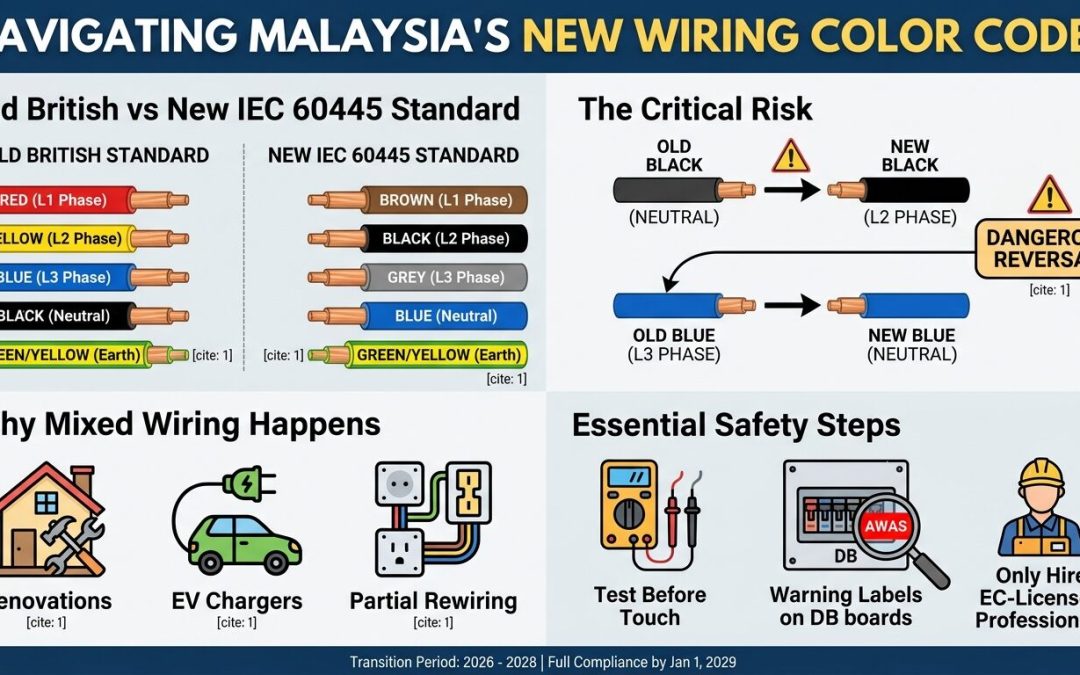
Under the old British Standard system, the color codes were as follows:
- The L1 phase conductor was Red.
- The L2 phase conductor was Yellow.
- The L3 phase conductor was Blue.
- The Neutral conductor was Black.
- The Protective Earth conductor was Green and Yellow striped.
Under the new IEC 60445 standard, the color codes have changed significantly.
- The L1 phase conductor is now Brown.
- The L2 phase conductor is now Black.
- The L3 phase conductor is now Grey.
- The Neutral conductor is now Blue.
- The Protective Earth conductor remains Green and Yellow striped.
The most critical change involves the Black and Blue conductors. Under the old system, Black was used for Neutral and Blue was a Phase conductor. Under the new standard, these roles have been reversed. Black is now a Phase conductor for L2, and Blue is now Neutral.
This reversal is considered the greatest safety risk during the transition period, particularly in facilities where old and new wiring coexist.
Why Mixed Wiring Colors Happen
You might wonder why your home would have both old and new wiring colors in the first place. There are several common scenarios.
Home renovations and extensions
If you have added a new room, extended your kitchen, or upgraded your electrical panel, the contractor may have used the new color codes for the new wiring while the rest of your home still uses the old system.
EV charger or solar installation
The installation of electric vehicle chargers or rooftop solar systems often involves new wiring that follows current standards, creating a mix with existing legacy wiring.
Distribution board upgrades
When upgrading your distribution board, the electrician may introduce new color-coded wires to connect the new components.
Partial rewiring
If only certain circuits have been rewired, those circuits will use the new colors while the rest of the house retains the old system.
The Institution of Engineers, Malaysia conducted a survey of 300 engineering professionals regarding this transition. The survey revealed that 67.33 percent of respondents expressed serious safety concerns about the coexistence of old and new color codes.
The Real Danger of Mixed Wiring
The primary risk with mixed wiring colors is human error. According to the IEM survey, 57.14 percent of professionals identified human error as the leading implementation risk during the transition.
Experienced electricians who have relied on color recognition for decades may incorrectly identify live conductors when working on a system with mixed colors. For example, a Black wire that was previously Neutral is now a live Phase conductor. If someone assumes it is Neutral based on old knowledge, the consequences could be fatal.
The survey report emphasized that the reversal of Blue and Black introduces a significant cognitive risk, particularly during maintenance of partially upgraded installations.
How to Identify If You Have Mixed Wiring
If you are unsure whether your home has mixed wiring colors, here are some indicators to look for:
Recent electrical work is the first indicator
If any electrical work was done after January 2026, there is a possibility that new color codes were used.
Check your distribution board
Look for warning labels. According to Energy Commission Directive No. 11/2026, if a premise contains a mixture of old and new color codes, warning labels with the word AWAS, which means Warning, must be clearly displayed on the distribution board or main switch board.
Look for labeling on new wires
New wiring should have durable labels identifying the conductors as L1, L2, L3, N, or PE.
Consider the age of your home
Older homes that have not had any recent electrical work are more likely to have only the old color codes. Homes built or renovated after 2026 are more likely to have the new codes.
What You Must Do: Essential Safety Steps
If you discover or suspect that your home has mixed old and new wiring colors, here are the steps you must take.
1. Never Trust Color Alone
This is the most important rule. The IEM and Energy Commission both emphasize that conductor colors serve only as a means of identification and must not replace proper verification procedures.
The Test Before Touch culture is being promoted as a mandatory safety practice. Before working on any electrical conductor, it must be tested with proper instruments to confirm its function and whether it is live.
2. Check for Warning Labels
If your distribution board does not have a warning label indicating mixed wiring colors, this is a problem. According to the directive, warning labels must be placed on the distribution board when mixed color codes exist.
The warning label should be at least 8 centimeters by 12 centimeters in size and clearly visible.
3. Ensure Proper Documentation
Your electrical circuit diagrams and connection charts should be updated to reflect the actual wiring in your home. The directive requires that if upgrade work involves the existing system, the original cable colors must be identified before making connections, and circuit drawings must be updated and kept.
4. Hire Only Licensed Electricians
The complexity of mixed wiring systems requires professional expertise. The Energy Commission and IEM both stress that electrical work should be performed by licensed electricians who are aware of the new standards and understand the risks of mixed wiring.
Do-it-yourself electrical work is strongly discouraged. As one industry expert noted, DIY is typically only suitable for changing light bulbs or simple socket repairs. Any work involving running or modifying wires must be handled by professionals.
5. Consider a Professional Inspection
If your home has had recent electrical work or you are unsure about the state of your wiring, a professional inspection is recommended. An electrician can verify the actual function of each conductor using testing instruments, ensure proper labeling, and identify any potential hazards.
When to Call a Professional
You should contact a licensed electrician immediately if you notice:
- a burning smell from electrical sockets or switches
- your distribution board does not have proper warning labels despite recent electrical work
- you are planning any renovation or electrical work
- you are experiencing frequent tripped breakers or flickering lights
- you are unsure whether your wiring complies with current safety standards
The Importance of Professional Assessments
The IEM survey revealed that only 21.63 percent of organizations reported they are fully prepared for the new color code transition. This suggests that many electricians and contractors may not yet be fully familiar with the new standards.
When hiring an electrician for work on a home with mixed wiring, ask about their familiarity with IEC 60445 and the Energy Commission directive. A qualified professional will understand the importance of testing rather than relying on color, and will follow proper labeling and documentation procedures.
Long-Term Benefits of Proper Management
Properly managing mixed wiring colors in your home provides several long-term benefits. These include:
- improved safety for you and your family
- reduced risk of electrical accidents and fires
- better documentation for future electrical work
- compliance with current regulations
- peace of mind knowing your electrical system is properly managed
Conclusion
The transition to new wiring color codes in Malaysia is a necessary step toward international standardization and improved electrical safety. However, during the transition period from 2026 to 2028, mixed wiring colors in homes pose genuine risks that must be managed carefully.
The most important takeaway is simple. Never trust wire color alone. Whether you are a homeowner or a professional, always verify conductor function with proper testing instruments before working on any electrical system.
If your home has mixed wiring colors, ensure proper warning labels are in place, keep documentation updated, and always hire licensed professionals for electrical work. By following these precautions, you can keep your home safe during this important transition.
FAQs
1. Do I need to rewire my home because of the new color codes?
No. Electrical installations that complied with regulations when they were installed remain valid and safe. The new color code mainly applies to new installations, major renovations, extensions, and future electrical works. You do not need to rewire your existing home simply because the standards have changed.
2. What does it mean if my home has mixed wiring colors?
Having mixed old and new wiring colors means that some parts of your electrical system use the old color codes while others use the new ones. This can happen after renovations, extensions, or upgrades. While this is not automatically unsafe, it does require proper labeling and documentation to ensure future work can be done safely.
3. How can I tell if a wire is live if I cannot trust the color?
The only safe way to determine if a wire is live is to use proper testing instruments, such as a voltage tester or multimeter. The Test Before Touch principle requires that all conductors be tested before any work is performed, regardless of their color.
4. What should be on the warning label for mixed wiring?
The warning label should be at least 8 centimeters by 12 centimeters and clearly display the word AWAS, which means Warning. It should be placed on the distribution board or main switch board to alert anyone working on the system that mixed color codes are present.
5. When will the old color codes be completely phased out?
Full compliance with the new IEC 60445 standard is required by January 1, 2029. From that date, all electrical wiring must comply with the new color codes.