
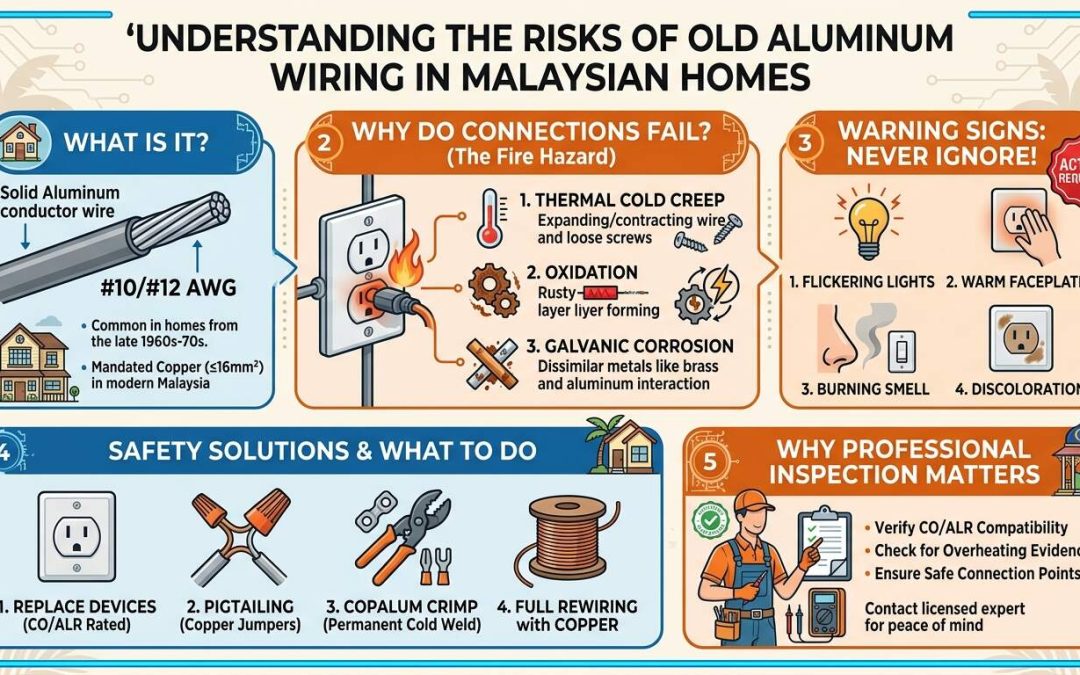
Aluminum wiring was once a common choice in residential electrical systems across many countries, including Malaysia. In the United States, it was widely installed between 1965 and the early 1970s as a cost-effective alternative to copper . While aluminum wiring itself is not inherently dangerous when properly installed and maintained, the connections in older aluminum branch circuits present a well-documented fire risk that many Malaysian homeowners remain unaware of.
For properties built during this era, or those still relying on original aluminum incoming supply cables from TNB, understanding the specific hazards of aluminum wiring is not merely a matter of compliance—it is a matter of safety.
This article examines why aluminum wiring fails, the warning signs homeowners should never ignore, and what options exist for making older Malaysian homes safe.
What Is Aluminum Branch-Circuit Wiring?
Aluminum branch-circuit wiring refers to the smaller-gauge aluminum conductors used to supply power to outlets, switches, and lighting circuits throughout a home. These are distinct from the larger aluminum service entrance cables that run from the utility supply to the distribution panel—a common sight in many Malaysian homes even today .
The safety concerns are specifically focused on solid aluminum wire in sizes #10 and #12 AWG (approximately 2.5mm² and 4mm²), which were commonly used for 15- and 20-ampere branch circuits . In Malaysian electrical regulations, copper conductors are mandatory for cable sizes 16mm² or less, meaning modern installations do not use small-gauge aluminum for branch circuits . However, older properties constructed before these requirements were strictly enforced may still contain aluminum branch wiring.
Why Aluminum Connections Fail
The problems with aluminum wiring are not caused by the wire itself, but by its connections at outlets, switches, and junction points. Three factors combine to create hazardous conditions:
Thermal Expansion and Contraction
Aluminum expands and contracts more than copper when electrical current passes through it. Over time, this repeated movement causes connections to loosen, a phenomenon known as “cold creep” . Loose connections create resistance, resistance generates heat, and sustained heat is the precursor to electrical fires.
Oxidation
Aluminum develops an oxide layer that acts as an electrical resistor, unlike copper oxide which remains conductive. This resistance further elevates temperatures at connection points .
Galvanic Corrosion
When aluminum comes into contact with dissimilar metals—such as the brass terminals found in standard receptacles and switches—oxidation accelerates, increasing resistance and heat buildup .
The U.S. Consumer Product Safety Commission (CPSC) has documented that homes with pre-1972 aluminum wiring are significantly more likely to experience electrical connections reaching “fire hazard” condition compared to homes wired with copper .
Warning Signs Malaysian Homeowners Should Never Ignore
The CPSC identifies several trouble signals associated with aluminum wiring problems. If you notice any of these in your home, seek expert advice immediately :
Warm or Hot Switch and Receptacle Faceplates
Cover plates that feel warm to the touch indicate heat buildup behind the wall. This is often the first sign of a failing connection.
Burning Plastic Odor
A strange or distinctive smell near outlets or switches—particularly the odor of burning plastic—suggests insulation is overheating due to excessive resistance.
Flickering Lights
Lights that flicker without any obvious external cause can indicate unstable connections in aluminum wiring circuits . In older Malaysian homes, this is sometimes dismissed as a nuisance when it may be an early warning of a serious hazard.
Discoloration Around Outlets
Brown or yellow discoloration on switch plates or outlet covers is a sign of overheating that should prompt an immediate electrical inspection.
The TNB Connection: Aluminum Incoming Supply Cables
Many Malaysian homes still use aluminum wiring for their incoming power supply from TNB . While larger aluminum cables have different performance characteristics than small branch-circuit wiring, they are not immune to the same fundamental issues. Aluminum is more prone to oxidation and thermal expansion, which can cause loosening at connection points, creating unstable current flow and eventual heat buildup .
This concern is particularly relevant for homeowners considering high-draw appliances such as EV chargers. A charger drawing 32 amperes continuously places significant stress on connection points. If those connections are already compromised by aluminum oxidation and thermal cycling, the risk of overheating increases substantially .
Solutions: What Can Be Done?
The good news is that aluminum wiring can be made safe. The question is not whether aluminum is present, but whether the connections are properly maintained and compatible with modern devices.
Replace Non-Compatible Devices
Standard electrical outlets and switches are not designed for direct connection to aluminum wiring. Replacement devices must be rated CO/ALR (Copper/Aluminum Revised), which feature tin-plated terminals designed to handle the creep issue . These devices are available from electrical supply shops in Malaysia. If your home has aluminum branch circuits with original non-rated devices, upgrading them is the minimum safety measure required.
Pigtailing with Copper
Pigtailing involves attaching short lengths of copper wire to the ends of aluminum wire using specialized connectors approved for aluminum-to-copper connections. This allows standard copper-rated devices to be used at the termination point. While pigtailing parts are relatively inexpensive, the technique requires specialized knowledge—a poorly executed pigtail can be worse than doing nothing .
COPALUM Crimp Connection
The COPALUM system, developed by Tyco Electronics and recognized by the CPSC, involves crimping a copper wire to aluminum using extremely high pressure to create a “cold weld” between the conductors . This method creates a permanent bond that eliminates arcing and glowing connections. However, it requires an electrician certified in the system, and availability may be limited in Malaysia .
Full Rewiring
In some cases—particularly when renovating or when aluminum wiring is extensive—rewiring with copper may be the most practical solution. Partial electrical rewiring in Malaysian homes typically costs between RM3,000 and RM12,000, with full rewiring starting from RM12,000 upward for terrace and semi-detached houses .
Why Professional Inspection Matters
The CPSC strongly advises that consumers without thorough electrical training should not attempt to inspect their own wiring systems or make any electrical repairs . This warning is particularly relevant for aluminum wiring, where the hazards are often hidden behind walls and only detectable through professional evaluation.
A qualified electrician inspecting aluminum wiring will examine:
- Whether outlets and switches are rated for aluminum (marked CO/ALR or AL/CU)
- Evidence of overheating at receptacles, switches, light fixtures, and panel connections
- The condition of connection points on heavily loaded circuits
- Whether anti-oxidant grease has been applied at larger aluminum connections
- The presence of any non-compatible twist-on connectors
When Should a Malaysian Homeowner Act?
Consider scheduling a professional electrical inspection if:
- Your home was built before the mid-1990s and retains original wiring
- You notice warm switch plates, flickering lights, or burning odors
- You are purchasing a pre-owned property and the electrical history is unknown
- You are adding high-draw appliances such as EV chargers or additional air conditioning units
- You are planning renovations that involve opening walls or modifying electrical circuits
Conclusion
Aluminum wiring in older Malaysian homes is not an automatic emergency—but it is a condition that demands attention. The hidden cost is not measured in ringgit alone, but in the potential for electrical fires that begin behind walls where warning signs remain invisible until it is too late.
The solutions exist: compatible devices, professional pigtailing, COPALUM connections, or selective rewiring. The critical first step is awareness and inspection. If your home contains aluminum branch-circuit wiring or you are uncertain about your electrical system’s age and composition, engage a licensed electrician to assess the condition of every connection. Peace of mind is worth the investment.
FAQs
1. How do I know if my Malaysian home has aluminum wiring?
Look for the markings on electrical cables visible in unfinished areas such as attics or garages. Aluminum wiring will have “Al” or “Aluminum” marked every few feet along the cable . A qualified electrician can also make this determination safely. Do not open your electrical panel yourself—this exposes live wires and poses an electrocution hazard .
2. Is aluminum wiring always dangerous?
No. Aluminum wiring, when properly installed with compatible devices and maintained connections, can be safe . The danger lies in deteriorating connections, not the wire material itself. However, pre-1972 aluminum wire used a utility-grade alloy (AA-1350) that is more problematic than later formulations .
3. Can I just replace my outlets and switches with standard ones?
No. Standard receptacles and switches are not compatible with aluminum wire. You must use devices marked CO/ALR or AL/CU, which are specifically designed to handle aluminum’s expansion and oxidation characteristics .
4. What is the safest repair method for aluminum wiring?
The COPALUM crimp connector system is recognized by the CPSC as providing a complete and permanent repair . Pigtailing with copper is also used, though its success depends heavily on proper execution . The appropriate solution depends on your home’s specific configuration and should be determined by a qualified electrician.
5. Will my home insurance cover aluminum wiring issues?
Coverage varies by insurer and policy. Some Malaysian insurers may require electrical inspection documentation or may exclude claims related to known aluminum wiring hazards if the homeowner failed to address identified risks. Consult your insurer directly and be transparent about your home’s wiring condition.