
Electrical wiring is the hidden network that powers every home in Malaysia. While we rarely think about the colored cables concealed behind walls and ceilings, understanding what each color represents is essential for safety. Whether you are a homeowner planning renovations, a tenant troubleshooting a faulty socket, or simply curious about the wiring in your property, knowing the color codes can prevent accidents and costly mistakes.
The challenge is that Malaysia is currently undergoing a significant transition in its electrical wiring standards. As of 2026, the country is moving from traditional British-based color codes to internationally harmonized IEC standards. This means homes across the country may contain either the old system, the new system, or even a mix of both depending on when they were wired or modified.
What Are Electrical Wire Color Codes?
Electrical wire color codes are standardized systems used to identify the function of different conductors within an electrical installation. These codes help electricians, technicians, and homeowners distinguish between live wires that carry current, neutral wires that complete the circuit, and earth wires that provide safety protection.
In Malaysia, the Energy Commission (Suruhanjaya Tenaga) regulates these standards to ensure consistency and safety across all electrical installations. Proper identification prevents accidental contact with live conductors, reduces the risk of electrical fires, and enables safe maintenance and repairs.
Malaysia’s Transition to New Wire Color Codes
Malaysia is adopting the IEC 60445 standard, which is internationally harmonized and replaces the traditional color coding system based largely on the former British standard. The Energy Commission issued Directive No. 11/2026 to mandate this transition, with implementation phased over several years.
Under the new directive, from January 1, 2026, both old and new color codes may be used for new installations, extensions, or renovation work. However, by January 1, 2029, all electrical wiring must fully comply with the new IEC color standards.
This transition period is designed to allow industry stakeholders to adapt through retraining and gradual phase-out of legacy systems. However, it also creates a period where both systems may coexist, making it even more important to understand both standards.
Old vs New: Complete Wire Color Comparison
Single-Phase Wiring (Typical Homes)
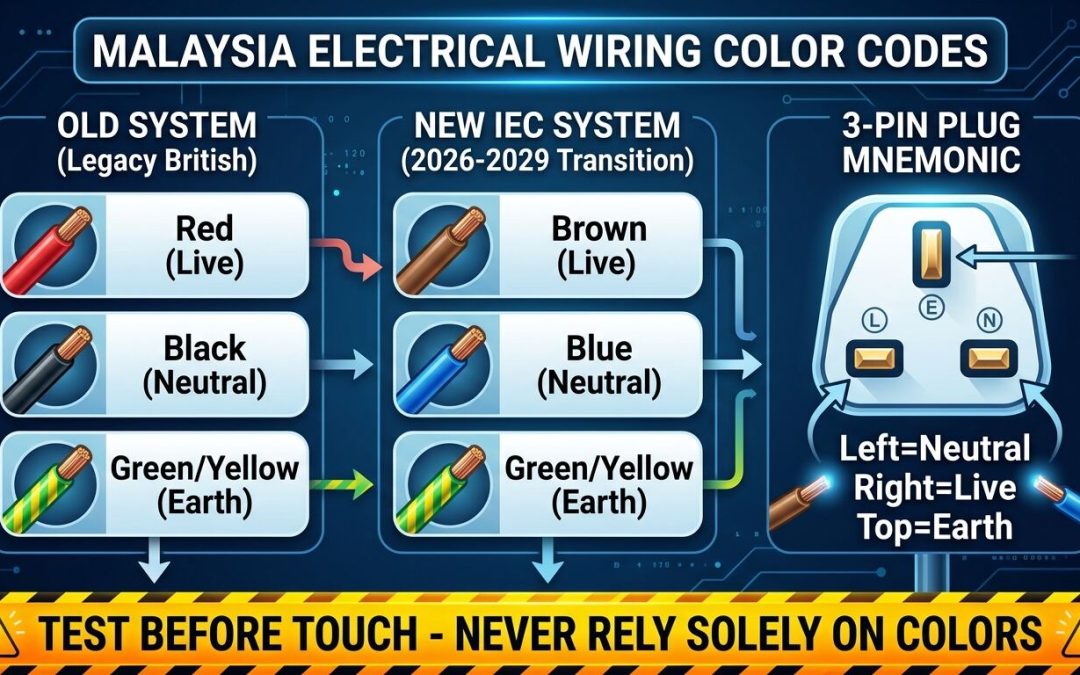
In the old color code system, the live wire is red, the neutral wire is black, and the earth wire is green or green-yellow. Under the new IEC standard, the live wire becomes brown, the neutral wire becomes blue, and the earth wire remains green-yellow.
Three-Phase Wiring (Commercial and Industrial)
For three-phase installations, the old system uses red for L1, yellow for L2, and blue for L3, with black as neutral and green-yellow as earth. The new IEC system uses brown for L1, black for L2, and grey for L3, with blue as neutral and green-yellow as earth.
The most critical change involves the interchange of black and blue conductors. Under the old system, black was neutral. Under the new system, black is a phase conductor (L2), while blue is neutral. This reversal presents the greatest safety risk during the transition period, especially in facilities containing a mixture of legacy and IEC-compliant wiring.
Understanding the Three Main Wires
Live Wire (L / Phase)
The live wire carries the electrical current from the source to your appliances and outlets. It is the conductor that poses the greatest shock risk. In Malaysia, single-phase supply operates at a nominal voltage of 230V. In older homes, look for red wires. In newer installations or recently modified circuits, the live wire is brown.
Neutral Wire (N)
The neutral wire provides the return path for electrical current, completing the circuit back to the supply source. Under normal conditions, it carries current but is generally at a voltage close to zero. Older wiring uses black for neutral, while newer IEC-compliant wiring uses blue.
Earth Wire (E / PE)
The earth wire is a safety conductor that does not carry current during normal operation. If a fault occurs and a live wire touches metal parts of an appliance, the earth wire diverts the current safely to the ground, preventing electric shock. Earth wires are consistently green or green-yellow in both old and new systems. This is the one color that has remained unchanged throughout the transition.
Identifying Wires at the 3-Pin Plug
Malaysian homes typically use the BS1363 three-pin plug standard. The pin arrangement follows a consistent pattern. The top pin, which is the longest, is the earth connection. The bottom left pin is neutral, and the bottom right pin is live.
A simple mnemonic to remember this arrangement is “Left equals Neutral, Right equals Live, Top equals Earth.”
When you open a three-pin plug, you will typically see a brown wire connecting to the live terminal on the right, a blue wire connecting to the neutral terminal on the left, and a green-yellow wire connecting to the earth terminal at the top. If the plug uses older wiring, you may see red for live, black for neutral, and green for earth instead.
Why You Should Never Rely Solely on Colors
Even before the current transition period, relying solely on wire colors was already considered unsafe practice. Malaysia’s adoption of IEC 60445 emphasizes that conductor colors serve only as a means of identification and must not replace proper verification procedures.
The engineering community has raised significant safety concerns about the transition period. According to a survey by the Institution of Engineers Malaysia, 67.33 percent of respondents expressed serious safety concerns about the conversion process, with 57.14 percent identifying human error as the primary risk, particularly in extensions, renovations, repairs, or replacement work where old and new color codes may coexist in the same electrical installation.
The core principle emphasized throughout the industry is “test before touch.” Always verify conductor function using appropriate test instruments before commencing any installation, maintenance, or modification work.
When to Call a Professional
While understanding color codes is valuable knowledge, certain situations absolutely require a licensed professional.
You should hire a certified wireman when performing any new wiring or rewiring work, adding new circuits or outlets, troubleshooting persistent electrical issues, working with three-phase systems, dealing with mixed old and new wiring systems, or any work that requires opening the distribution board.
Malaysia’s electrical work is regulated by the Energy Commission, and workers on electrical installations must hold competent certificates. For residential wiring, a wireman with appropriate restrictions, either Single Phase or Three Phase, is required depending on the scope of work.
The penalties for non-compliance with electrical regulations are serious. Under Section 50E of the Electricity Supply Act 1990, violations can result in fines up to RM200,000, imprisonment up to two years, or both.
Conclusion
Understanding electrical wiring color codes in Malaysia is more important than ever during this transition period. While the shift to IEC 60445 standards represents an important step toward international harmonization, it also creates a period of complexity where both old and new systems coexist.
The single most important takeaway is this: never assume a wire’s function based solely on its color. The safest approach is to always verify with proper testing instruments and to engage a certified wireman for any work beyond the most basic tasks. Electrical safety is not an area where shortcuts are acceptable. The risks to life and property are too great.
Whether you are a homeowner in a newly built property with IEC-compliant wiring or living in an older home with the traditional color scheme, understanding these codes empowers you to make informed decisions and communicate effectively with electrical professionals.
FAQs
1. What are the current wire color codes in Malaysia?
For single-phase home wiring, the old standard uses red for live, black for neutral, and green-yellow for earth. The new IEC standard uses brown for live, blue for neutral, and green-yellow for earth. Both standards may be in use until January 1, 2029.
2. Why is my neutral wire black in one place and blue in another?
Malaysia is transitioning from the old British-based color code to the IEC standard. Black was previously neutral but is now used for L2 phase in three-phase systems. Blue was previously L3 phase but is now neutral. This transition period allows both systems to coexist, but proper labeling is required when both are present in the same installation.
3. Is it safe to do my own electrical work in Malaysia?
Minor tasks like changing a light bulb or resetting a circuit breaker are safe for homeowners. However, any work involving opening the distribution board, adding circuits, or modifying wiring should only be performed by a certified wireman. The risk of electric shock and legal consequences for non-compliant work are significant.
4. How can I tell if my home uses old or new wiring colors?
Check the wires visible at your plug points, switches, or light fixtures. If you see red and black wires, your installation likely uses the old standard. If you see brown and blue, it uses the new IEC standard. However, because installations may have been modified over time, the only reliable method is verification with a test instrument by a qualified person.
5. What should I do if I find mixed wiring colors in my home?
Do not attempt to work on the wiring yourself. Mixed old and new wiring systems present elevated safety risks due to potential confusion between conductors. Contact a licensed wireman to inspect your installation and ensure proper labeling is in place. Under the new directive, any installation containing mixed color codes must have clear warning labels indicating “AWAS” or Caution at the distribution board.