
Electric vehicles (EVs) are growing rapidly in popularity across Malaysia. Owning an EV offers lower operating costs, a smoother drive, and reduced carbon emissions. However, transitioning to an electric vehicle requires a reliable and convenient way to charge your car overnight.
While public charging stations are expanding along highways and shopping malls, the vast majority of EV charging happens at home. Installing a dedicated Level 2 AC wallbox charger at home transforms your driveway or porch into a personal fuel station.
Installing an EV charger is not as simple as plugging a regular appliance into a standard wall socket. It involves a high continuous electrical load that requires careful assessment, dedicated wiring, safety protection devices, and full compliance with Malaysian electrical guidelines.
What Is a Home EV Charger Installation?
A home EV charger installation involves setting up a dedicated Level 2 Alternating Current (AC) wallbox charger directly connected to your home’s main Distribution Board (DB).
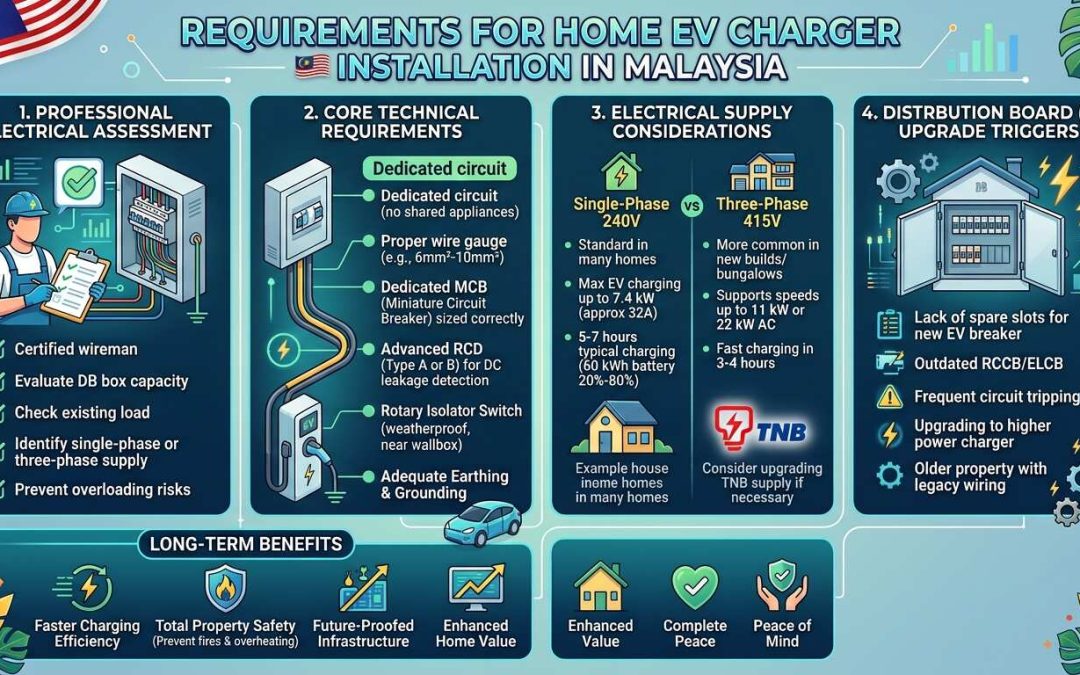
During a professional installation, certified electricians assess and set up:
- Electrical supply capacity (Single-Phase vs. Three-Phase)
- Main Distribution Board (DB) capacity and protective devices
- Circuit Breakers (MCB) and Residual Current Devices (RCCB / Type A or Type B RCD)
- High-spec dedicated copper cabling from the DB box to the charger site
- Isolator switch installation near the wallbox unit
- Earthing system and surge protection setup
- Testing, commissioning, and safety verification
The primary objective is to deliver consistent, high-amp power to your electric vehicle without overloading your home’s existing electrical infrastructure.
Why Proper Electrical Assessment Is Important Before Installation
Plugging a high-power EV charger into an unverified or outdated home electrical system can lead to serious risks. EV charging draws continuous high power for several hours, putting sustained thermal stress on your wiring.
A thorough professional assessment prior to installation helps homeowners:
- Prevent unexpected circuit tripping when using household appliances concurrently
- Identify outdated DB boxes or damaged wiring before failure occurs
- Prevent severe cable overheating, electrical fires, and voltage drops
- Determine if a single-phase to 3-phase upgrade with TNB is necessary
- Protect expensive EV battery systems against power surges and neutral faults
- Ensure long-term compliance with Suruhanjaya Tenaga (Energy Commission) guidelines
Early evaluation prevents costly emergency electrical repairs or structural damage to your home.
Identifying Crucial Requirements for Home EV Chargers
Installing an EV wallbox requires meeting specific electrical standards to manage continuous heavy current.
Key technical requirements include:
- Dedicated Circuit Run
- Proper Wire Gauge (mm²)
- Correct Circuit Protection
- Advanced Residual Current Protection
- Rotary Isolator Switch
- Adequate Earthing & Grounding
Neglecting these core elements exposes your property to dangerous thermal degradation and potential fire risks over extended charging sessions.
Protecting Your Property, Vehicle, and Electrical System
A high-powered EV charger is one of the heaviest electrical loads a residential property can draw.
Without a certified installation that meets Energy Commission standards, homeowners face severe risks:
- Continuous DB Box Tripping
- Cable Melting & Fire Hazards
- Vehicle On-Board Charger Damage
- Voided Warranties & Insurance Claims
Working with competent wiremen ensures proper load distribution, correct safety tripping speeds, and complete protection for both property and vehicle.
Single-Phase vs. Three-Phase Electrical Supply in Malaysia
The speed and capacity of your home EV charger depend heavily on your property’s electricity supply type from Tenaga Nasional Berhad (TNB).
Understanding the differences helps you choose the right charger setup:
Single-Phase Supply (240V)
- Standard in many terrace homes and older landed properties.
- Supports up to 7.4 kW of charging power (drawing approximately 32A).
- Takes roughly 5 to 7 hours to charge a standard 60 kWh battery from 20% to 80%.
Three-Phase Supply (415V)
- Frequently found in newer semi-detached homes, bungalows, and upgraded properties.
- Supports charging speeds up to 11 kW or 22 kW using AC wallboxes.
- Completes the same 20% to 80% charging cycle in as little as 3 to 4 hours.
If your household currently operates on a single-phase supply with high daily energy demands, upgrading your TNB incoming supply to three-phase may be recommended before wallbox installation.
When Should an Electrical Upgrade Be Performed?
Homeowners should consult a qualified electrician for an upgrade or DB modifications when:
- The current DB box lacks spare physical slots for a dedicated EV breaker.
- The main house RCCB/ELCB is outdated or lacks proper DC leakage detection.
- Daily household consumption already causes occasional power trips.
- Upgrading from a basic 7.4 kW single-phase charger to an 11 kW 3-phase charger.
- Moving into an older property with legacy wiring or inadequate earthing.
A site audit determines whether your current electrical board can absorb the extra load or if panel modifications are required.
Why Certified Electricians Are Essential Over DIY Methods
While plug-in portable chargers (3-pin plug cables) exist, relying on standard household wall outlets for daily EV charging is strongly discouraged. Standard 13A home sockets are not built to deliver continuous maximum current for 8–12 hours continuously.
Certified wiremen bring vital expertise:
- Knowledge of Suruhanjaya Tenaga (ST) and MS IEC 60364 safety standards
- Expertise in calculating load management and cable sizing
- Access to specialized testing meters for earth resistance and RCD trip timing
- Proper torqueing of DB connections to prevent loose connection arcing
Professional execution eliminates dangerous shortcuts, giving you confidence every time you plug in your vehicle.
Long-Term Benefits of Proper Home EV Charger Setup
Investing in a compliant, professionally installed home charging point yields significant long-term benefits.
Benefits include:
- Maximum Charging Efficiency
- Total Property Safety
- Future-Proofed Infrastructure
- Enhanced Home Value
- Complete Peace of Mind
Setting up your home charging point correctly from day one avoids costly rework and safeguards your home for years to come.
Choosing a Qualified Electrical Service Provider
When selecting a wireman or electrical contractor for your EV charger installation, look for providers who offer:
- Competent wiremen certified by Suruhanjaya Tenaga
- Transparent on-site electrical load inspections and quotations
- Clear compliance with local Malaysian wiring regulations
- High-quality materials (SIRIM-approved breakers, heavy-duty armored cables)
- Comprehensive end-to-end testing (earth fault, insulation, and full load tests)
Partnering with experienced electrical professionals ensures your home EV charger is installed safely, efficiently, and responsibly.
Conclusion
Installing a home EV charger is a crucial step in enjoying the full convenience of electric vehicle ownership in Malaysia. By ensuring your property’s electrical system meets TNB and Energy Commission safety standards—through correct cable sizing, dedicated DB circuit protection, proper earthing, and single or three-phase load planning—you create a seamless charging experience.
Investing in professional site inspections, proper wiring, and certified installation services protects your vehicle, preserves your home’s electrical health, and delivers total peace of mind for every drive.
FAQs
1. Can I charge my EV using a standard 3-pin home socket in Malaysia?
While emergency 3-pin trickle chargers can be plugged into standard 13A wall sockets, they are very slow and not recommended for everyday use. Standard sockets are not designed for sustained high-amperage draws over long periods, which can cause socket overheating, melting, or fire hazards. Installing a dedicated Level 2 wallbox with proper wiring is the safest and fastest solution.
2. Do I need to upgrade to 3-phase electricity to install a home EV charger?
Not necessarily. A single-phase electricity supply can support a 7.4 kW AC charger (32A load), which is sufficient for overnight charging for most daily commutes. However, if your home already uses heavy appliances or if you want faster 11 kW to 22 kW charging speeds, upgrading to a 3-phase supply with TNB is highly recommended.
3. What specific safety devices are required for an EV charger DB box?
An EV charger installation requires a dedicated Miniature Circuit Breaker (MCB) sized appropriately for the unit, a Residual Current Device (RCD) with DC leakage protection (Type A with 6mA DC detection or Type B RCD), a separate rotary isolator switch near the wallbox, and proper earthing protection to prevent shock hazards.
4. How long does a home EV charger installation take?
A standard installation typically takes between 3 to 6 hours depending on the complexity of the cable route from your DB box to your charging location, wall penetrations needed, and whether any main panel upgrades are required on the day of installation.
5. What factors affect the overall cost of home EV charger installation?
Key cost factors include the distance between your DB box and the charger location, whether cable trunking or armored cabling underground is needed, DB panel capacity upgrades, addition of specialized RCD/MCB breakers, and whether your home requires a single-phase to 3-phase TNB supply upgrade.